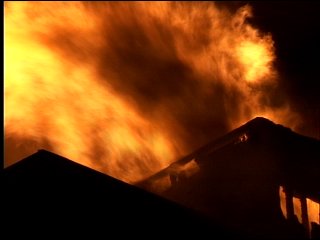
Showing posts with label Fire safety. Show all posts

Monday, October 29, 2012

OSU fraternity to check residents’ smoke alarm

OSU fraternity to check residents’ smoke alarm:

Members of the Sigma Phi Epsilon fraternity at Oregon State University will be going door-to-door today in the 5000 block of N.E. Elliott Circle to check residents’ smoke alarms.
The students will be in the neighborhood from 5 to 7 p.m., with replacement batteries for smoke alarms that need them and smoke alarms for homes that are without them.
The fraternity is providing the batteries, and the office of the state fire marshal tutored the volunteers and is supplying the smoke alarms.
The campaign is being conducted as part of National Fire Safety Month.

Wednesday, July 28, 2010

Illinois Signs Law for Sprinklers in Greek Houses

Quinn signs college sprinkler bill at ISU

By Michele Steinbacher

NORMAL - Gov. Pat Quinn used the backdrop of an Illinois State University dorm on Tuesday to sign a law expanding requirements for sprinklers for fraternities and sororities associated with Illinois campuses.

The state’s fire safety experts recommended the legislation, said Quinn. “Firefighters know when you install sprinklers you are protecting the people,” he said.

House Bill 5664 requires fraternity and sorority housing to be equipped with automatic sprinkler systems. This goes into effect Jan. 1, 2011, for new construction and January 2019 for existing fraternity and sorority houses.

“Embrace this (law) as if it were your child sleeping in the Greek housing,” said Kathleen Moritz of Evergreen Park, who attended Tuesday’s event. Her son, Tanner Osborn, was a 22-year-old college student who died in a 2005 apartment fire in Chicago.

Quinn also spoke of another recent law he signed that requires all housing units in Illinois to have a backup power supply for smoke detectors run on the building’s electrical system. Sites affected include houses, apartments, nursing homes and other residential units constructed or substantially renovated after Jan. 1, 2011.

Praising the new sprinkler system law, Normal Fire Chief Mick Humer said only three ISU-sanctioned fraternities and sororities currently have such sprinkler systems.

“It’s one of those things where it’s an added layer of safety,” said Humer.

ISU is home to more than 30 fraternities and sororities - about two-thirds of those have off-campus houses. At nearby Illinois Wesleyan University, 12 chapters have houses.

Quinn mentioned two fires at the IWU campus as evidence such a sprinkler law would improve the safety of students. In January 2008 a fire at the Phi Mu Alpha house displaced 15 men, and a September 2005 fire at the Sigma Pi house severely injured one student.

The backup-power legislation followed a 2009 fire at Southern Illinois University-Edwardsville. In that incident, a smoke detector failed because a storm had knocked out power.

“These laws will help prevent potentially tragic situations like we saw last year at (SIU),” Quinn said.

ISU President Al Bowman said Tuesday a backup system is being installed at Watterson Towers, and work will follow at other dorms.

http://www.pantagraph.com/news/local/education/article_cf8c04ca-99f0-11df-ad83-001cc4c03286.html

Thursday, May 20, 2010

Fraternity Fire Prevention Bill Passes House

U.S. House passes bill aimed at preventing campus fires

By Sabrian Eaton

WASHINGTON, D.C. - The House of Representatives on Wednesday agreed to a longtime priority of the late Stephanie Tubbs Jones: a bill establishing grants for installation of fire prevention and suppression technologies for university student housing, including fraternities and sororities.

When Tubbs Jones died in 2008, her successor, Warrensville Heights Democratic Rep. Marcia Fudge, took up the cause and renamed the bill the "Honorable Stephanie Tubbs Jones College Fire Prevention Act."

It passed the House of Representatives on a voice vote.

The legislation doesn't specify the scope of grants that would be available. At least 10 percent of the money would be reserved for institutions that primarily serve minorities, and another 10 percent would be reserved for fraternities and sororities.

Sen. Sherrod Brown, an Ohio Democrat, has introduced a companion bill in the U.S. Senate, which is before the Senate Health, Education, Labor, and Pensions Committee. Brown said the bill honors Tubbs Jones' legacy by protecting Ohio students and preventing deaths.

Brown's office estimates there are between 1,500 and 1,800 fires each year in college residence halls, dormitories, and sorority or fraternity houses. In Ohio, there have been at least 13 deaths and 36 fire-related campus incidents since 2000. When fire suppression technology is present in student housing, the chance of surviving a fire increases by 97 percent and property damage is lowered by 35 percent, Brown's office says.

http://www.cleveland.com/open/index.ssf/2010/05/us_house_passes_bill_aimed_at.html

Saturday, March 13, 2010

How Well Are You Prepared for a Fire?

Surprise fire alarms used to test evacuation methods at University of Michigan fraternities, sororities

By Tom Perkins, Freelance writer for AnnArbor.com

At the sound of the fire alarm, the fraternity house cleared out within 40 seconds.

Half its occupants fled to the rear of the large home, and a small group gathered out front as an Ann Arbor Fire Department truck rolled up, lights flashing and sirens blaring.

Their evacuation method was exactly what Jim Rampton, community disaster education coordinator for the Red Cross, cautioned the residents against doing in the event of a real fire.

In this case, it was a surprise fire simulation being used to test the fire safety preparedness of some of the University of Michigan fraternity and sorority houses in the city.

The new initiative is a collaboration between the Washtenaw County Red Cross chapter, Ann Arbor Fire Department and U-M’s Greek Life organization. The purpose is to educate fraternity and sorority houses on the necessity for fire evacuation procedures and protocol.

Rampton used it as a lesson to inform the Phi Delta Theta members of the correct way to evacuate a burning house.

“If you take one thing away from this, it’s have a designated gathering spot out front where you all can account for one another,” Rampton told the roughly 26 residents.

Rampton explained fraternities and sororities are particularly at risk because so many students live in a small area. At Phi Delta Theta, 26 students live in 12 rooms, and Rampton added many of them are living on their own for the first time.

Rampton also pointed out the University of Michigan has the oldest and one of the largest Greek networks, and many of the houses are more than 100 years old. That means they’re

“Some of these houses are very flammable,” he said. “What would normally take a couple minutes to burn would take a couple seconds instead.”

Rampton said Greek houses differs from dorms, which are typically better regulated by the university. He called the simulations an effective tool for preventing a tragedy.

“It’s an opportunity for some outreach, especially with a group of students that are high risk,” he said. “It’s a really good chance and way to get them thinking some of these things.”

The Washtenaw County Red Cross chapter and city Fire Department are arranging simulations throughout the Greek community with only the house president aware, leaving the others to suspect it's a true emergency. To add to the authenticity, an AAFD truck rolls up, along with a Red Cross emergency vehicle.

Once the firefighters are out of the truck, and the residents are informed about what’s taking place, they all meet inside to discuss what happened and how to improve evacuations.

Rampton said he hasn’t been particularly encouraged with the reactions thus far, but is optimistic the initiative will improve the situation.

“Unfortunately, from what I’ve seen so far and from the responses that I’ve gotten, only one house actually has a plan,” he said. “Some are so limited in their knowledge that they have no idea of what to do, which is why this is helpful - they’re getting a taste of what they should expect in real life situation.”

In the case of Phi Delta Theta, at the corner of Washtenaw and South University avenues, the students' reaction to the fire alarm was both positive and negative.

While the fire alarm and fire extinguishers had been inspected by the fire marshal three months earlier, not everyone had been properly trained on how to use them.

More importantly, the house didn't have an evacuation plan or system for accounting for its occupants.

“We hadn’t really thought about it before, but that’s one of the things we can do now,” house president Tom Hardenbergh said, holding up a packet containing Red Cross suggestions on improving evacuation procedures and statistics on fires in university homes.

Hardenbergh added he was pleased with how quickly everyone reacted and gathered in groups, but believes it can be accomplished in a more orderly fashion.

“We know everyone has a sense of what to do, but we were not as organized as we need to be,” he said, adding that developing a plan will be placed at the top of the priority list.

Ann Arbor Fire Captain Jim Budd also made several recommendations. He pointed out the fire doors meant to prevent flames from spreading from room-to-room were propped open.

He also said if an emergency occurs, house officials should clear the building immediately and have a sober representative work with fire officials, which he said has presented problems on previous calls to fraternities and sororities.

“What I ask from you gentleman is that you treat firefighters with respect,” he said.

In 2008, a fire at a fraternity house near campus gutted the historic home - but it was during the summer, so few people were living there at the time. No one was injured.

“That was what spurred on this idea - looking at those pictures of that house,” Rampton said.

FEMA statistics show there were 3,800 university housing fires between 2005 and 2007. Of confined fires, roughly 80 percent are cooking related. Intentionally set fires, open flames and unintentional fires comprise the bulk of uncontained fires.

http://www.annarbor.com/news/u-of-m-greek-homes-tested-in-fire-emergency-simulation

Sunday, September 06, 2009

UW Sig Eps Learn Fire Safety First Hand

UW students play "fire fighter" to learn fire safety

MADISON (WKOW) - Some UW students played firefighter in an effort to learn the importance of fire safety.

Donning helmets, jackets and other fire gear, a group of student leaders got some hands on experience at the Madison Fire Department's Fire Academy.

Tasks included carrying a hose up three flights of stairs, spraying a fully pressured hose, and putting out flames with a fire extinguisher.

The run through was especially significant to the members of the Sigma Phi Epsilon fraternity, their house burned down last year.

"I wish we had this before the house burned down, I mean now that I've done this, it's truly educational and I am glad everyone is doing this," frat member Anthony Colon.

Madison Fire officials say the Sigma Eps fire last year is an example of how students living off campus are more vulnerable to fires and fire fatalities.

MFD spokesperson Lori Wirth says the event also focused on the city's new fire alarm ordinance.

It requires working alarms in all rental properties and they must be hardwired or have a non-removable 10 year battery.

Wirth says they stressed the importance of having them and not tampering with them.

"Landlords can't be at properties each day to check to see if people are taking batteries out of smoke alarms. We have tamper resistant smoke alarms and citations for those who tamper with it," Wirth says.

The fine for tampering with an alarm is $172 for the first offense.

Before burning down last year, the Sig Eps house passed recent inspections and had a fire alarm system, but no sprinkler system.

In 2007, one person died at a fire off campus on Bedford Street. That home had no working smoke detectors.

Saturday, May 09, 2009

UT House Has Fire Code Violations

Come on guys. You can do better than this...
State fire marshal finds code violations at 2 UT frat houses
Katie Shands

The state fire marshal found code violations at two University of Tennessee fraternity houses. If the issues are not corrected, the residents will be forced to leave the buildings.

The City of Knoxville Fire Department filed complaints against the Pi Kappa Phi and Sigma Phi Epsilon fraternity houses. KFD officials said they responded to alarms at both facilities and noticed exposed electrical wiring, trash blocking exits, and parts of the ceilings missing.
[...]
The report said an emergency light in the Sigma Phi Epsilon house was vandalized and didn't operate. A plugged-in extension cord ran outside into a puddle of water under a wet cardboard box, posing an electrical hazard, according to the state fire marshal. A "heavy fire load" was found in the kitchen, especially on top of the stove. The floors below the exits were covered in broken glass, trash, and slippery substances.

The report stated that in order for the Sigma Phi Epsilon residents to remain in the house they must clear the exits, repair emergency lighting, and have a State Electrical Inspection.

Wednesday, January 07, 2009

2 UT-K fraternity houses re-opened after fire code violation repairs

It looks like TN Alpha is back in business. They have made the needed repairs, but have not been inspected yet. A "fire watch" has been set up so the house can open for the spring semester.
KNOXVILLE (WATE) -- Members of two University of Tennessee fraternities were allowed to move back in their fraternity houses Monday after making improvements following fire code violations.

Pi Kappa Phi was one of three fraternity houses forced to close due to violations.

Since that time, the fraternity has installed a new smoke detection system in its house.

Members of Sigma Phi Epsilon were also allowed to move in Monday. However, they remain on fire watch until their house is re-inspected on Thursday.

Lambda Chi Alpha is still working to fix the violations at its house, which also gets re-inspected Thursday.
The best fix for the 40-plus-year-old house will come when a long awaited rebuilding effort is completed and there is a new house from the ground up.

2 UT-K fraternity houses re-opened after fire code violation repairs

Tuesday, May 13, 2008

Update: Madison House Total Loss

Update: Thanks to this eyewitness blog report for the picture which we totally stole!
Another blog has several pictures.
A TV news site with video
The University of Wisconsin Greek system has a page with all the latest updates.

Update: Frat fire cause unknown; damage estimated at $750,000
Samara Kalk Derby
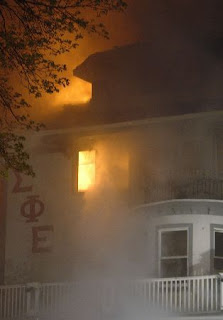
Instead of cramming for finals, 25 members of the Sigma Phi Epsilon fraternity sat on a Metro Transit bus early this morning at the corner of Langdon and Frances streets keeping warm as dozens of Madison firefighters battled a massive fire that enveloped their fraternity house.

The fire department got the first call at 11:41 p.m. Monday after a city of Madison police officer noticed a glow that she thought was a grill at the back of the house, said Madison Fire Department spokeswoman Bernadette Galvez. When the officer investigated she found that the back of the house was on fire, Galvez said.

"It's good to know everybody's out and safe," she said at the scene as the firefighters behind her pumped 1,000 gallons of water a minute into the top level of the three-story wooden house at 237 Langdon St.

The investigation into the fire was just beginning Tuesday morning as firefighters continued to put out hot spots and were most likely to be on the scene throughout the morning.
"We're just being able to get inside the building," Galvez said. "We still have a ladder up, putting out spot fires."

No cause of the fire had been determined yet. The Madison Police Department is assisting in the investigation.

Fire Chief Debra Amesqua ordered all of the firefighters to leave the house because she feared structural collapse, Galvez said.

"A lot of fire was coming out of that building," she said. "Once fire gets into the attic, that's free space for it to burn."

The fire was put out about three hours later at 2:38 a.m. A cause won't be determined for a few days, Galvez said.

Damage is estimated at $750,000.

Police officers sealed off Langdon Street at Frances Street, so spectators wouldn't get in the way of the firehoses. About 100 onlookers, mainly students, gathered at the corner. Dozens more congregated in front of the Campus Inn, where the bus was parked sheltering the fraternity brothers.

Langdon Street was still blocked by fire equipment at 6 a.m. Madison police said the street will most likely be blocked through the morning commute, so motorists should use alternate routes.
"It's still smoldering," said Division Chief Arthur Price. "There's still smoke and steam coming out of it."

Price said it was hard to say just how long firefighters would remain on the scene.

"It's an old, Victorian building," Price said, "with a lot of nooks and crannies. We want it out."
The Madison Fire Department sent 14 vehicles to the fire and a total of 48 personnel, including chiefs, Galvez said. One firefighter suffered a non-life-threatening injury and was taken to UW Hospital, and another suffered from dehydration and exertion, she said.

The Sigma Phi Epsilon house, built in the 1890s, is nestled into the bend on Langdon Street. Emergency workers evacuated the two buildings on either side of the house, neither of which was damaged by the blaze. Residents of the neighboring buildings were allowed back in at 3 a.m.
The 13-bedroom house was completely repaired after a fire in the summer of 1999 that caused $500,000 in damage. Because it was summer, there were only six residents and one guest staying at the house at the time.

"This is the different in that it's a total loss," said Ryan Sugden, vice president for the Sigma Phi Epsilon alumni board, who lived in the house from 2003 to 2005. This time, there were 25 fraternity members living in a house that at maximum occupancy can house 30, Sugden said.
"It's a total loss. Nothing will be recovered from that house," he said.

Sugden said that after the 1999 fire a new fire alarm system was installed in the house. "That played a role in getting all the residents out safely," he said.

The building did not have a sprinkler system, he said, a fact pointed out by Galvez, the fire department spokeswoman, who said that all newer construction student housing has sprinkler systems.

Ald. Eli Judge, who represents the UW campus and lives across the street, began to smell smoke and hear sirens at 11:50 p.m. He went outside and saw the back of Sigma Phi Epsilon on fire.
"Almost immediately, fire trucks started pulling up. I think the fire department's done a remarkable job tonight, especially with the nature of these old houses in the Langdon area," he said.

As a student, Judge sympathized with the fraternity members. "It doesn't help that it's the middle of finals week," he said.

Sugden noted that more than half of the victims have finals Tuesday.

UW-Madison Dean of Students Lori Berquam was also concerned about the impact of finals week and pointed out that the victims will not be able to access the materials they need to study.
"Most of them were only able to get out with the clothes on their back, maybe their bookbag, so we wanted to certainly support them during this terrible situation and give them the resources that they need to carry on," she said.

Berquam said the fraternity members all indicated that they had friends to stay with immediately and didn't need Red Cross support. "Where they will be staying in the coming days, that we need to work on," she said.

Argyle Wade, associate dean in the Offices of the Dean of Students, said his office will issue checks from the "Student Crisis Loan Fund," a fund established for emergencies through private donations. The fraternity members will be able to purchase what they need -- clothing, food, housing and other basic essentials -- to get them through finals, Wade said.

His office will also be contacting the students' professors to ask for further assistance in helping the victims complete their class work for the rest of the semester. Health services and counseling services on campus will also continue to make resources available, he said.

"Beyond that, it's working one-on-one. Each student will have unique needs," Wade said.
The fraternity made news last week as UW-Madison officials investigated a possible reverse hazing incident at the frat in which human excrement and vomit were dumped on fraternity members.

Sugden said he was grateful for all the help and concern at the scene. "The support from the community -- from the dean of students, students, the Red Cross, Madison police and fire -- has been overwhelming and very much appreciated," he said.

He said that for the hundreds, if not more than 1,000, "Sig Eps" who have lived in the house and used it as a fraternity home for the past 10 or so years, the house holds a lot of history and memories.

"It's a tough loss for us, but thankfully everybody is out safely. That's the most critical aspect of this."

Saturday, February 16, 2008

UNL Greeks Practice Fire Safety

UNL fraternity holds fire drill to educate students
BY LISA MUNGER / Lincoln Journal Star

Opaque gray smoke poured from a fraternity house’s second-story windows Saturday in a mock fire simulated to help students practice fire safety.
Alarms rang out from inside the fraternity, audible on the sidewalk outside. Students emerged from the front doors of the house casually talking, some women clutching their purses.
Fraternity and sorority members were invited to participate in the drill at the Alpha Gamma Sigma house on the University of Nebraska-Lincoln’s East Campus in response to several Greek house fires in recent years, both at UNL and Nebraska Wesleyan University.

“We wanted to show Greek students how difficult it can be to escape from a fire,” said Alex Wolf, a UNL student and public relations chairman of the Interfraternity Council, which organized the event.
The simulation was a part of the All-Greek Liability Summit, which aimed to help fraternity and sorority members understand issues of legal liability.
Students worked with Lincoln Fire and Rescue to stage the fire, which included theatrical smoke. Lincoln fire inspector Rick Campos presented tips on escaping safely from fires.
Wolf said the IFC has taken a number of steps to tighten fire safety in fraternity houses, including outlawing tobacco products and requiring outside commercial fire alarm monitoring.
Tom Foreman, a member of Sigma Alpha Epsilon, participated in the drill.“I didn’t expect that much smoke,” he said. “It was disorienting; it really makes you think about safety.”
Powered By Blogger