Media Credit: Joe Koshollek/Milwaukee Journal Sentinel/MCT
A group plays a game of beer pong on front lawn of a fraternity house near the University of Wisconsin-Madison before a recent Wisconsin-Northwestern game.
|
|
I remember the early games of beer pong, before there were rules and leagues and fancy cups. Back then, they called the game Beirut. Back then, people dove for the balls when they fell off the table.
We played on an old closet door we ripped off the hinges at of our east Tempe apartment complex. We used an odd assortment of plastic cups from Taco Bell and whatever else we could find.
And we got drunk - a lot - playing those games. It seems like that's the only thing about beer pong that hasn't changed since my Arizona State days in the mid 1990s.
Beer pong is big business now. There's an official beer pong league, and scores of informal bar leagues. There's a documentary making the film festival circuit. There are stores dedicated almost primarily to beer pong supplies and accessories.
It's hard to find a college student who doesn't know what beer pong is.
It wasn't always like that.
East Coast, represent
First, a disclaimer: I, in no way claim to be a part of the group of people who brought the beer pong movement to Arizona. All I claim is that back in 1995, when we - that is, my friends and I - threw a party in the Phoenix area, and you asked some random guests if they wanted to play Beirut, they had no idea what you were talking about. You had to explain the rules. How to throw, how to drink, how to re-rack.
If a game was already going on, people would line up around the table, waiting for a chance to get in. I had first learned the game in New Jersey - from friends who had older brothers or sisters in schools like Bucknell, Rutgers and Villanova, which makes sense.
By most amateur historians' accounts, the beer pong most people at Phoenix-area colleges that people play today - the sport that the game's founders called Beirut - was developed some time in the mid 1980s at either Bucknell or Lehigh University.
In 2004, Duane Kotsen, president of Theta Delta Chi in 1985 at Lehigh University, told The Dartmouth Independent that the game derived its name from the scenes Americans were seeing on television at the time from the Lebanese Civil War.
"I believe that the game got its name based on an analogy between the Ping-Pong balls flying across the table and landing on the opponent's side and an idea that the US should bomb Beirut as a result of the casualties in the area," he said.
Brian "Stubby" Poulton, a brother at Theta Delta Chi, was known as the organizer of the games and is credited for spreading the game to other houses.
But in that same 2004 article, Stubby told the paper that he first observed a crude form of the game in 1983 at Bucknell.
Amateur historians, at this point, seem to give Beirut's founding shared credit between the two schools.
Paddle patrol
There is no denying, however, where the real beer pong - that's the beer pong played with paddles - got its origins: Dartmouth College.
Exactly how beer pong with paddles is played tends to vary by school and by decade. Arizona State even had its own version of beer pong in the mid 1990s (more on that in a second), but the fact that it began at Dartmouth seems indisputable.
In fact, Wikipedia claims that the earliest known picture of beer pong is in the 1968 Dartmouth yearbook, Aegis, on page 304; a fact that current Aegis yearbook editor Alyssa Eisenberg confirmed for College Times late last week.
"I looked it up, and I am very impressed with Wikipedia's information," she wrote. "There is a picture of students playing beer pong in the 1968 Aegis."
Dartmouth actually recognized beer pong as an official intramural sport from 1970 to 1977, further solidifying the school's stature as the birthplace of college student's favorite party game.
Valley fever
How the game got to Arizona and Valley colleges, however, is more difficult to track down.
Sometime in the mid 1990s, probably somewhere between 1993 and 1996, several student organizations at ASU, including members of the ASU water ski team, began playing a variation of the beer pong played at Dartmouth, using paddles.
Crystal Petrocelli, a water ski team member in the mid 1990s, said, unlike today's beer pong, the winner in these early days was the team who finished all their beer first, not the other way around, as it is today.
Game play went as follows:
A cup was placed on each corner of the ping-pong table. Players played normal ping-pong, with the object being to hit the ball off of your opponents' cup, causing the ball to fly as far away from the table as possible. Once the ball was off the table, the person who successfully smashed the ball off the table started drinking until the opposing team ran and got the ball and placed it back on the table.
Play continued like this until one team finished all their beer. The person who finished all their beer stayed at the table to play another opponent.
Several fraternity members College Times spoke to said they never really saw Beirut or beer pong played in the their houses during this time frame. Clint Corey, a Sig Ep member and Valley freelance writer, said he didn't see Beirut played regularly until he started bartending in Reno about seven years ago.
Even by the early 2000s, beer pong had not meshed fully with college culture, especially in the Western US.
But Beirut was being played in the mid-1990s in the Phoenix area, even if by a small, but devoted following - including me and my friends and the guests of weekly parties we threw at Tempe apartment complexes and later the homes we rented.
These were legendary parties, sometimes drawing 200 or 300 people at a time. Guests would blow through four or five kegs in a few hours. The rules are similar to what they are today, except they were a little more violent - opponents could fight over ping-pong balls that landed on the ground.
By the mid 2000s, though, beer pong had taken off in every corner of US. And in 2006, the sport received de-facto professional status when the World Series of Beer Pong held its first annual tournament in January 2006 at the Oasis Hotel and Casino in Mesquite, Nevada.
That first year, the winner was given $10,000 in prize money. The following year, the prize money was doubled to $20,000.
In 2009, the WSOBP officially moved to the Strip is Las Vegas. It is now held at the Flamingo Hotel & Casino. Winners receive $50,000. There is an additional $15,000 in prize money awarded to lower finishers.

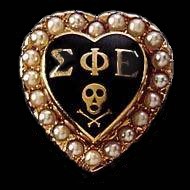 “Mommy, what’s that?” my daughter said as I pinned on my husband’s Sig Ep badge under my Pi Phi arrow while getting ready for an alumnae event. “It’s Daddy’s fraternity pin,” I said. “I didn’t know Daddy was a pirate,” said my daughter, who was three or four at the time, after seeing the skull and crossbones on the badge. This conversation took place more than two decades ago, and a smile comes to my face every time I think about it.