T10_5_Facility_Closure_Best_Practices:


News and opinion for all the SigEp brotherhood. SigEp's "unofficial" blog.

 Labels:
AVC,
Holiday,
Housing,
Training in 10
Labels:
AVC,
Holiday,
Housing,
Training in 10
 The fraternity had been without a house since May 2011, when damages from an unsanctioned Senior Week alumni party prompted SigEp’s landlords to refuse the organization’s return to the 114 Curtis Street residence.
Labels:
Accomplishment,
Community relations,
Housing
The fraternity had been without a house since May 2011, when damages from an unsanctioned Senior Week alumni party prompted SigEp’s landlords to refuse the organization’s return to the 114 Curtis Street residence.
Labels:
Accomplishment,
Community relations,
Housing
 |
| A 1996 fraternity house fire at the University of North Carolina that killed five students spurred the industry’s drive for the tax break. About half of all fraternity houses lack sprinklers, according to an internal industry memorandum reviewed by Bloomberg News. Photographer: Joe Weiss/Durhan Herald-Sun via AP Photo |
 |
|
This fall, the former Sigma Phi Epsilon fraternity house at
Virginia Tech will become the Innovate living-learning community, which will include three dozen students. |
Labels:
Accountability,
Housing,
Suspension
 Virginia Tech’s Sigma Phi Epsilon Fraternity, commonly known as Sig Ep, has helped to start the Oak Lane expansion with the building of their new fraternity house.
Labels:
Campus Relations,
Greek housing,
Housing
Virginia Tech’s Sigma Phi Epsilon Fraternity, commonly known as Sig Ep, has helped to start the Oak Lane expansion with the building of their new fraternity house.
Labels:
Campus Relations,
Greek housing,
Housing
Michigan Alpha Sig Eps are moving in to an old church. Lets hope that they have the heavy duty lightning rods installed.Time capsule commemorates church's past - The Michigan Daily:
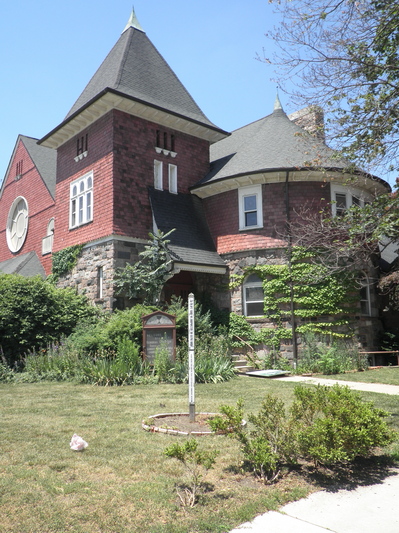 |
| New home of Michigan Alpha |
In all seriousness, this is a great way to preserve an historic structure and keep it useful.


 |
| Undergrads and alumni gather to enjoy the newly renovated house. |
City to keep hands off frat houses
By Daniel Dale
Annex fraternities and their wary neighbours should continue to work out their problems on their own, city staff say in a report that opposes new licensing rules.
Councillor Adam Vaughan had asked the city to come up with a licensing plan after residents who live near a cluster of University of Toronto fraternity and sorority houses complained of unruly late-night parties and other nuisances.
The licensing department said blitzes could be conducted to enforce existing rules. But it argued against imposing new ones. It said it cannot license fraternities as businesses or rooming houses. And it said that the community’s own efforts to improve the situation “hold the promise of a grassroots solution.”
Vaughan agreed. He said neighbours’ complaints are “way down” in the past year, as “the fraternities and sororities have taken responsibility for the behaviour of their members.” And he said the community is close to finalizing a system for resolving disputes.
There are 24 fraternities and sororities in the area, according to Vaughan (Ward 20, Trinity-Spadina). He said “one or two” are a problem, down from about six last year.
David Harrison, chair of the Annex Residents’ Association, said he did not want to express an opinion until he consulted with his neighbours. But he said the situation had improved only because residents had “spent hours and hours and hours” working on it. They do not want to have to do so again, he said.
“Perfection, is, I suppose, out of the question. It is better. But each year it’s a different story because each year you have different people in every fraternity,” Harrison said. “I think we certainly have the attention of the elders of these fraternities, who seem to genuinely want to improve things. But what we’ve looked for is: If self-regulation were to fail, then what?”
The self-regulation system, according to the report, relies in part on the “Greek Council” system that governs fraternities. The council, city staff said dryly, “can influence the individual chapters under the threat of ‘shunning.’” If chapters continue to behave badly, the international organizations they belong to could take away their official status.
“That’s when they become eligible for licensing as a rooming house,” Vaughan said.
The fraternities’ spokesperson could not be reached Wednesday.
SDSU could have ‘Fraternity Row’
by Vicki Schuster
Some “displaced” South Dakota State University fraternities and sororities may, in the not-too-distant future, have a new home to call their own.
Last week, the South Dakota Board of Regents approved a master ground lease with the State College Development Association that will enable creation of 4.7 acres near McCrory Gardens for a Greek Village.
One parcel of land for future development is between FarmHouse and the Brookings Fire Station on the 700 block of 20th Avenue. A second lot is on the other side of Alpha Gamma Rho, which is across the street to the north of FarmHouse.
Marysz P. Rames, vice president of student affairs, says the plan honors the original agreement SDSU made with the Greek life system almost four decades ago. Rames said since 1972, that land was set aside to be developed for Greek chapter houses.
“At the time, the banking industry was quite different, so … (Alpha Gamma Rho) and FarmHouse were able to build their chapter houses.”
But since then, Rames explained, the banking industry has undergone changes and “so the way the land is currently written up in South Dakota codified law, our Greek chapters could not get bankable loans to build out there.”
Rames cited a “reversion clause” in the codified law concerning land and the improvements of the land that made the loans difficult to obtain.
$1-a-year leases
The newly approved master ground lease will allow other Greek chapters to obtain loans to build houses on land that will be subleased from the State College Development Association for $1 per year on 99-year agreements.
The bank loan would be repaid with rent from the tenants of the chapter houses.
Rames says a few local fraternities have been “displaced” in the past few years – by fires and plans for university parking lots – and may find the idea of a ground lease appealing.
She says Chi Omega members have been living in the residences halls since the university bought their chapter house several years ago.
A February fire at Sigma Alpha Epsilon (SAE) has also scattered those members into rental units around town. SAE President Drew Carwile said since the incident – which was caused by a damaged electric power strip – members and alumni have been working on building a new house for SAE, whether it’s on existing property or one of the Greek Village lots.
“We all are excited with the prospects of our new house and are taking the necessary steps to build, whether we build on our lot south of campus or in one of the Greek Village lots,” he said.
Rames said Sigma Phi Epsilon, now located at 804 Sixth Ave., has also been renting and reports that its members are excited by the idea of a Greek Village, as well as, Ceres, another SDSU women’s sorority.
“We’ve been trying to figure out a way to give these chapters an option – and it’s strictly an option at this point – to build out there,” said Rames. “This ground lease gives them an opportunity.”
Definite interest
Carwile says there is definite interest for SAE to approach the university, “but right now we are keeping all our options open,” he said. “There is still a lot of work to be done on our side and SDSU’s side as well in order to … make the idea of a unified Greek community on Greek Village a reality.”
No fraternity or sorority has talked about building or moving in the near future, but Rames says she welcomes any ideas.
“Right now we are in the process of letting the Greek chapters know it went through and talking with them to see what interest there is. And depending on the interest, having a discussion on how we can allocate some lots,” she said.
300-plus in Greek life
Addie Wolcott, Greek Life adviser at SDSU, says there are currently six male fraternities and four female fraternities with a total active membership of about 300.
She did not attend the regent’s meeting but is excited for the idea of a Greek village. “I’ve spoken to other Greek officials at other universities, and this would be a great way to unify the campus and the community,” she said. “It would be great to have a unified presence near campus by having all of the houses together.”
Rames agreed. “Many universities are doing this, and we thought it would be great to have all of our Greek chapters together. It would really build some unity.”
Carwile said there are several advantages to having a central location for Greek housing. “The impact of having a line of nice Greek houses would be beneficial to recruitment to our fraternity and, more importantly, to Greek life in general,” he said.
“It would also foster more inter-fraternal interaction between not only the men’s fraternities but also the women’s fraternities ...”
http://www.brookingsregister.com/v2_news_articles.php?heading=0&story_id=8585&page=76
Labels:
Housing
Greek housing expands Georgia State’s community
Georgia State has expanded its university housing once again. Greek housing will be opened this August for select sororities and fraternities.
The Greek housing will consist of nine three-story town homes. Each sorority and fraternity will have a choice of one, two, or three bedroom suites, which comes out to a total of 145 beds. The town homes will include laundry facility and a common room.
Each sorority/fraternity chapter will have a Residental Assistant (RA) who is a member of their chapter. An RA is a hired student who watches over the living space to ensure that students are being safe and following the rules. There are three floors in each town house. The first floor will include a kitchen, a common area, a bathroom facility, and bedrooms. The two upper floors will contain a bathroom and a common area, along with more bedrooms.
Students are excited to start living in Greek housing.
Georgia State sophomore and Alpha Xi Delta member Jenn Twitchell said, “I’m really excited for Greek housing because of the fact that it is making us like other schools. Other schools get to have a place for their chapters to meet and hang out in a home setting. This will bring our chapter together, because we actually get to live together and bond more closely.”
Every sorority and fraternity cannot have all of their members live in the housing facility. After certain requirements are met, such as GPA requirements, the specific chapter decides on who will reside in the Greek housing.
Anyone who is in a chapter will be able to get into the common room on the first floor with card access. Only residents of Greek housing will be allowed access to the specific town homes. Guests will need to be checked in at the front desk.
Parking will not be available for Greek housing, but students can park in the University Lofts parking deck. This parking deck is across the street on Edgewood Ave. For more information on this, students can visit Auxillary Services on the second floor of the University Center.
Greek housing is the fifth housing unit that Georgia State students have lived in. The University Village, which is now owned by Georgia Tech, was the first housing facility. The Village was built for the 1996 Olympics and sold to Georgia State shortly after. The University Lofts, built in 2001, holds all students, including undergraduates and graduates. Greek housing is the third housing development to be opened recently for Georgia State, the previous ones being the Commons, built in in 2007, and the Freshman Dormitories, which were built last year. This new housing is serving in Georgia State’s goal of having 20 percent of their students living on campus by 2015.
Carleston Sanford of Atlanta is designing the Greek Housing.
For more information about Greek housing or other housings facilities, visit the housing website at www.gsu.edu/housing or visit the Central Housing Office in room 250 of the Student Center.
Labels:
Housing
U.S. House passes bill aimed at preventing campus fires
By Sabrian Eaton
WASHINGTON, D.C. - The House of Representatives on Wednesday agreed to a longtime priority of the late Stephanie Tubbs Jones: a bill establishing grants for installation of fire prevention and suppression technologies for university student housing, including fraternities and sororities.
When Tubbs Jones died in 2008, her successor, Warrensville Heights Democratic Rep. Marcia Fudge, took up the cause and renamed the bill the "Honorable Stephanie Tubbs Jones College Fire Prevention Act."
It passed the House of Representatives on a voice vote.
The legislation doesn't specify the scope of grants that would be available. At least 10 percent of the money would be reserved for institutions that primarily serve minorities, and another 10 percent would be reserved for fraternities and sororities.
Sen. Sherrod Brown, an Ohio Democrat, has introduced a companion bill in the U.S. Senate, which is before the Senate Health, Education, Labor, and Pensions Committee. Brown said the bill honors Tubbs Jones' legacy by protecting Ohio students and preventing deaths.
Brown's office estimates there are between 1,500 and 1,800 fires each year in college residence halls, dormitories, and sorority or fraternity houses. In Ohio, there have been at least 13 deaths and 36 fire-related campus incidents since 2000. When fire suppression technology is present in student housing, the chance of surviving a fire increases by 97 percent and property damage is lowered by 35 percent, Brown's office says.
http://www.cleveland.com/open/index.ssf/2010/05/us_house_passes_bill_aimed_at.html
Labels:
Fire safety,
Housing

JUSTIN COOK The Roanoke Times
The first phase of the approved expansion plan for Virginia Tech's Greek housing includes space for five new buildings that could house up to 220 students.
The plan, approved by the Tech's board of visitors last week, would expand the on-campus Oak Lane Community near the Duck Pond from 13 buildings to up to 30 at final buildout.
Currently, Oak Lane accommodates 12 sororities and four fraternities in 13 buildings.
The first phase of the approved expansion plan includes space for five new buildings that could house up to 220 students. The $2 million to $4 million structures could be customized and would be built adjacent to the Tech golf course under a cost-sharing agreement between the university and the organizations.
Construction will be funded through university construction bonds, with the Greek chapters contributing about a third of the total cost as a tax-deductible contribution to the Tech Foundation.
Students living in the new buildings would pay a housing fee similar to those living in newer dorms. Oak Lane is part of the university's student-housing network.
At least three Greek organizations must commit to the project before construction can begin, and a handful have already shown interest.
Sigma Phi Epsilon is moving forward with preliminary plans to build in the new development.
"The alumni board has been working with the university for several years to improve the Greek system at Tech," said Bill Thomas of Sigma Phi Epsilon.
The chapter has about 60 student members, seven of whom live in the group's 100-plus-year-old house on Clay Street in Blacksburg.
Given its age, maintenance costs and design as a single-family home, it has never been ideal as housing for fraternity members. A new, customized building that could house more of the chapter's members could strengthen the organization, Thomas said.
The group has yet to sign a lease with Tech, but is looking at hiring an architect and builder.
"We know this is going to be a win-win for the university and the fraternity and the Greek system as a whole," Thomas said.
Moving fraternity housing out of Blacksburg neighborhoods could also help with another problem: reducing the perennial lifestyle conflicts between students and permanent residents.
Complaints about noise, parties and litter can become a drain on the local police force and town staff that field the complaints, as well as cause tensions between neighbors.
"We are interested in building the strength of the Greek community by having more chapters housed on campus and, in the process, decreasing the number of chapters out in the local communities," Vice President for Student Affairs Ed Spencer wrote in an e-mail.
And town officials are happy, too. Blacksburg Mayor Ron Rordam applauded the Oak Lane expansion plan.
"For years we have been encouraging the university to build more Greek housing on campus," he said.
Oak Lane was founded in 1983 and expanded in 1990 and 2001. Tech's Greek community comprises 65 nationally affiliated fraternities and sororities.
Labels:
Housing

The Greek community at the University of South Carolina has been growing at an extremely fast pace over the past five years. Its membership has swelled to almost 3,800 Greeks, who compose just under a fifth of the entire undergraduate population.
The current Greek Village is home to about 700 students in nine sororities and 11 fraternities. Although many universities have housing for Greek members, USC is unique. Not only is the Greek Village run by USC’s Office of Greek Life, but also each fraternity and sorority’s house corporation.
There are many advantages to owning a house. According to Greek Life’s Web site, positive outcomes of the project include greater alumni participation, increased recruitment numbers and higher levels of chapter accountability.
“We are trying to create the premier Greek Community in North America,” said Greek Life director Ron Binder in a meeting last Saturday with sorority Pi Chis. “It’s not my job to locate land and build new houses, but I do know that we need them.”
Currently there are a total of 34 Greek organizations on campus with only 20 houses. Many Greek students agree with Binder’s statements. There are currently fraternities in McBryde on campus that are simply outgrowing their allotted space.
“I think we’ve been ready for a long time for a house,” said Phi Sigma Kappa brother Sam Bacon. “Having a house in the Greek system would both make housing easier on us and make recruits more likely to get to know us better.”
Already this year there have been two new additions to the Greek Community at USC. Phi Mu sorority and Alpha Epsilon Pi fraternity have both joined USC this fall and would take advantage of an opportunity to be a part of a new Greek community. Phi Mu, with 252 members in its first year, has the numbers to have a house of its own.
The main problem with building a new Greek Village is simply the lack of University funding to buy land.
“The University would like to acquire more land for additional Greek housing, but the budget situation doesn’t permit that right now,” said Margaret Lamb, Media Relations Director for USC.
The ideal place to put new houses would be near the current Greek Village, but there is one problem.
“If we were to use those lots, we would have to move the existing train tracks, and that costs millions of dollars that we don’t have,” Binder said.
While land is owned by the University, each separate house is privately owned and operated by an Alumni House Corporation. According to a map on the University’s Web site, there is room for one more house on the side of Sigma Phi Epsilon, but no organization has claimed it yet.
“One thing is for sure. When plans finalize on a new Greek Village, it will be just as nice as the current one,” Binder said. “We are on our way to having the premier Greek Community in North America, and a new village would certainly add to that.”
Labels:
Greek housing,
Housing
“The Towers will not serve as a home to the active members, but it will serve as a gathering place for alumni. I also think the Towers will become a source of pride for the chapters living there. Hopefully, they will outgrow the space in Todd and Dupree, and we will look at building chapter houses.”
Labels:
Campus Beautification,
Housing

Michael Abramowitz/The Daily Reflector
Workers put a fence railing on the porch of the new addition to the Sigma Phi Epsilon fraternity house on Tuesday
Community members, ECU staff and faculty, and many Greek alumni will join students in an event to celebrate Sigma Phi Epsilon's new home, according to a university news release.
The program will emphasize the new safety precautions that Sigma Phi Epsilon has taken to make the home one of the safest in the country, the release said.
ECU Environmental Health and Safety as well as ECU Student Legal Services will distribute information throughout the event.
Scheduled speakers include Patrick Sebastian, IFC president; Brad Congleton, Student Government Association president, and Ryan Harris, Sigma Phi Epsilon president.
The new structure will be open from 3-6 p.m. for tours, and the program will begin at 5 p.m. The event is open to the public.
ECU's Assistant Director of Greek Life Keith Tingley said the house opening sets a good example for ECU's Greek Life community.
“After the horrible incident in the spring, Sigma Phi Epsilon is now able to be a campus-wide leader in fire safety. Their new house will be equipped with all tools needed to keep students safe in the case of a fire,” he said.
On the morning of Jan. 30, a fire destroyed the two-story auxiliary house being leased by the fraternity and located behind the main fraternity house. Nine students living in the house were safely accounted for after the fire. One student was treated for burn injuries.

State fire marshal finds code violations at 2 UT frat houses
Katie Shands
The state fire marshal found code violations at two University of Tennessee fraternity houses. If the issues are not corrected, the residents will be forced to leave the buildings.
The City of Knoxville Fire Department filed complaints against the Pi Kappa Phi and Sigma Phi Epsilon fraternity houses. KFD officials said they responded to alarms at both facilities and noticed exposed electrical wiring, trash blocking exits, and parts of the ceilings missing.
[...]
The report said an emergency light in the Sigma Phi Epsilon house was vandalized and didn't operate. A plugged-in extension cord ran outside into a puddle of water under a wet cardboard box, posing an electrical hazard, according to the state fire marshal. A "heavy fire load" was found in the kitchen, especially on top of the stove. The floors below the exits were covered in broken glass, trash, and slippery substances.
The report stated that in order for the Sigma Phi Epsilon residents to remain in the house they must clear the exits, repair emergency lighting, and have a State Electrical Inspection.
Labels:
Fire safety,
Housing
The stimulus plan emerging in Washington could offer an unprecedented, multibillion-dollar boost in financial help for college students trying to pursue a degree while they ride out the recession.There is more, including the disclaimers about what is getting cut, but lets hope those idiots in Washington stumble over each other and get it right, this time. Maybe there is even hope for the bill authorizing tax deductions for fraternity house building and renovation contributions.
It could also hand out billions to the states to kick-start idled campus construction projects and help prevent tuition increases at a time when families can least afford them.
[...]
"We're ready to go, there's great jobs involved, and we're educating kids who wouldn't have other opportunities if we weren't there," Chuck Middleton, president of Roosevelt University in downtown Chicago, said Sunday. His university has a $135 million new building with classrooms, labs, dorms and offices on hold after financing dried up. Construction could be under way in six months, he says, providing 600 jobs for two years while helping Roosevelt's diverse student body.
Also helping students, the House and Senate both call for expanding the Hope tuition tax credit from $1,800 to $2,500 and making it partly refundable. Now, almost half of families with children pay no income tax, so the current tuition tax-credit system doesn't help them (the full benefit kicks in for families earning at least $43,000).
